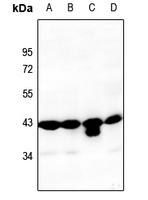
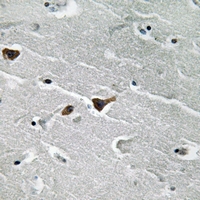
Product Name :PAI-1 (N315) polyclonal antibody
Reactivity :Human, Mouse, Rat
Application_all :WB: 1:500~1:1000
IHC: 1:50~1:200
Background :PAI-1 is a secreted protein that belongs to the serine proteinase inhibitor (serpin) superfamily. It inhibits urokinase and tissue plasminogen activators (uPA and tPA) and thus, reduces the conversion of inactive plasminogen to plasmin. PAI-1 regulates fibrinolysis and plays an important role in vessel patency and tissue remodeling. Secreted PAI-1 interacts with the extracellular matrix (ECM) component vitronectin, thereby modulating cell-ECM interactions. PAI-1 is expressed in a variety of tissues with higher expression in liver, vascular endothelial cells, platelets, macrophages, and adipose tissue. Increased levels of PAI-1 are associated with deep vein thrombosis. Defects in PAI-1 cause plasminogen activator inhibitor-1 deficiency (PAI-1D), which is characterized by increased bleeding after injury or surgery. Research studies have shown that high levels of PAI-1 are associated with obesity, aging, insulin resistance, and type 2 diabetes. PAI-1 is transcriptionally regulated by TGF-β and mediates TGF-β-induced inhibition of cell migration and invasion in cancer cells. Studies have also shown PAI-1 to be involved in fibrosis.
Product :Rabbit IgG, 1mg/ml in PBS with 0.02% sodium azide,50% glycerol, pH7.2
Purification&Purity :The antibody was affinity-purified from rabbit antiserum by affinity-chromatography using epitope-specific immunogen and the purity is > 95% (by SDS-PAGE).
Storage&Stability :Store at 4°C short term. Aliquot and store at -20°C long term. Avoid freeze-thaw cycles.
Specificity :PAI-1 (N315) polyclonal antibody detects endogenous levels of PAI1 protein.
Note :For research use only, not for use in diagnostic procedure.
Alternative Name :PAI1; PLANH1; Plasminogen activator inhibitor 1; PAI; PAI-1; Endothelial plasminogen activator inhibitor; Serpin E1
Immunogen :KLH-conjugated synthetic peptide encompassing a sequence within the center region of human PAI-1.